
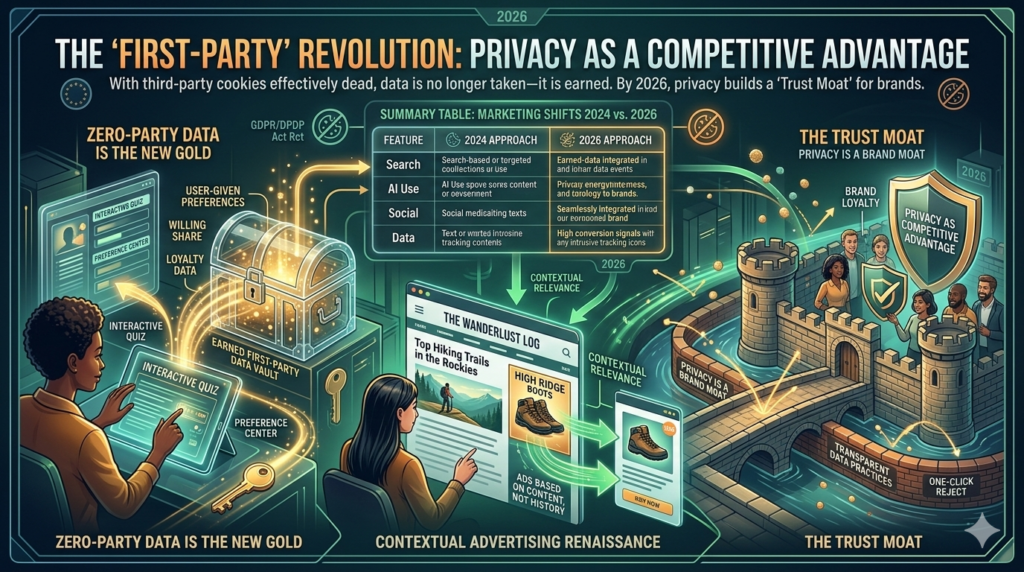
The “First-Party” Revolution: Privacy as a Competitive Advantage
With third-party cookies effectively dead and global privacy laws (like the GDPR and India’s DPDP Act) tightening, data is no longer something you “take”—it’s something you earn.
Zero-Party Data is the New Gold: Since brands can no longer track users across the web, they are turning to “Zero-Party Data”—information users willingly share via interactive quizzes, preference centers, and loyalty programs.
Contextual Advertising Renaissance: Instead of following a user based on their history, marketers are returning to Contextual Targeting. By placing ads based on the content of the page (e.g., an ad for hiking boots on a travel blog) rather than the user’s personal data, brands are finding high-intent audiences without infringing on privacy.
The Trust Moat: Privacy is no longer just a legal hurdle; it’s a brand moat. Transparent data practices and “one-click reject” buttons on cookie banners have become trust signals that actually increase long-term customer loyalty.
Summary Table: Marketing Shifts 2024 vs. 2026
| Feature | 2024 Approach | 2026 Approach |
| Search | Keyword-based (SEO) | Intent-based (AEO/GEO) |
| AI Use | Generating text/images | Orchestrating workflows & agents |
| Social | Awareness & Clicks | End-to-end Social Commerce |
| Data | Third-party cookie tracking | First-party & Zero-party data |